

European payments.
Connected. Simplified.
An intelligent orchestration layer connecting accounts, cards and domestic payment systems through trusted AI.
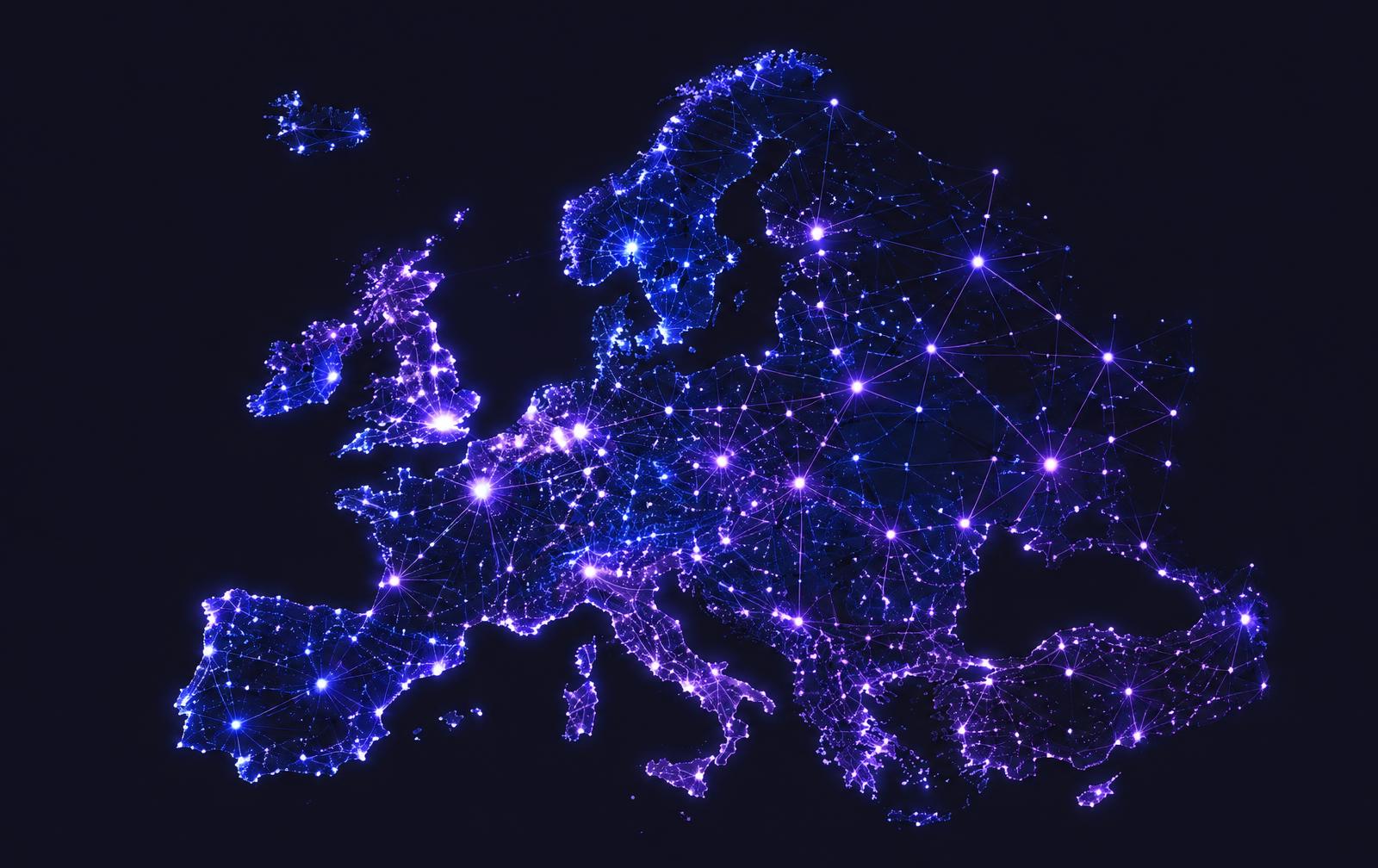
The diagnosis
Europe doesn't lack payment infrastructure. It lacks orchestration.
Payments have evolved from a back-office function into critical digital infrastructure — shaping access to commerce, data flows and economic participation. Yet Europe's challenge is not technological scarcity but coordination failure: domestic schemes, A2A overlays and federation initiatives coexist without a common trust and orchestration layer.
LIBERO re-designs payment as strategic digital infrastructure: a Pan-European, AI-native payment and data trust layer that connects existing accounts, cards and domestic schemes into one seamless continental experience.
Why a new layer is necessary
Payments have become intelligent, data-intensive and AI-driven — but trust, clarity and inclusion have not kept pace. New fraud rules, more wallets or extra compliance controls are not enough. What's missing is a foundational layer that:
- →Restores trust at the moment of transaction
- →Rebalances data power in favour of citizens
- →Keeps digital payments accessible to all
- →Moves organisations from reactive control to anticipatory governance
Without it, Europe risks deeper dependency on external platforms, wider social exclusion and payments becoming a source of fragility rather than resilience.
What LIBERO intends to build
Not a single product or scheme, but a governable, explainable platform that sits above existing rails and orchestrates them — citizen-centric and trust-by-design:
The dependency gap · ECB 2025, Eurostat 2025
01 · Overview
LIBERO connects Europe's payment systems
A proposed orchestration layer connecting existing accounts, cards and domestic schemes — built on existing rails, powered by trust, data and agentic AI.
One payment experience
LIBERO payment orchestration
- 01Identify the payee
- 02Compare eligible routes
- 03Coordinate with partners
Shared data and controls support routing, fraud detection and coaching.
Rails
Illustrative connections, subject to partner access
Why now — Europe's dependency gap
LIBERO builds no rails and holds no balances. It restores trust at the moment of transaction, rebalances data power towards citizens, keeps digital payments accessible to all and moves organisations from reactive control to anticipatory governance.
02 · AI capabilities
Three AI capabilities, one governed platform
Each workflow has a defined task, approved tools and clear limits on its authority.
Intelligent Routing
Intelligent Routing
Rules define eligibility. ML ranks routes. Generative AI explains choices and supports exceptions.
Rail directory, FX quotes, route scoring and status APIs
Approved policies constrain execution.
Fraud Intelligence
Fraud Intelligence
Rules and ML detect risk. Generative AI supports investigation. Humans review consequential exceptions.
Event streaming, rules engine, supervised ML, autoencoders, graph database, behavioral intelligence solutions, LLM
Policy triggers holds or extra checks.
Financial Coaching
Financial Coaching
Generative AI explains spending using verified calculations, helping customers make informed decisions with consent.
Transaction ledger, budget calculator, approved knowledge retrieval
Customers retain control over spending.
Scoped access and consent checks. Audit trails and escalation to human review.
Validate against baselines: accuracy, latency under load, cost per outcome, fairness and safe fallback.
06 · AI tool stack
A tool stack supporting European sovereignty
Preliminary design choice. Procurement depends on benchmark results and data-processing terms.
How we chose — decision criteria
Accuracy, latency and complex multilingual tasks. Routing and fraud scoring run inside 40 ms; no payment ever waits on a language model.
~759 payments/s average, 10× peak. Tokens grow from ~12tn (2029) to 115tn (2031).
Model chosen per task, cached prompts, per-user token budget for the coach. AI line held to €37m in 2031.
All transaction data processed inside the EU, in every phase. Encryption, tokenisation, least privilege.
Bias and disparity testing, EU AI Act and DPIA per use case, disclosed AI interaction, human review.
Rules-only is the baseline. GenAI adds interpretation of ambiguous language and documents.
Frontier models via EU-region endpoints carry the pilot (2027–28) → Mistral-class open weights on LIBERO's own EU cluster from 2029 → sovereign service with a payment foundation model from 2032.
Technical quality, peak-load integration, total cost, data protection and ethical outcomes. BioCatch, Featurespace and Feedzai are market references, not signed suppliers.
07 · Trust, inclusion & resilience
Trust, inclusion and resilience by design
Use only necessary data. Keep people in control. Test continuity before launch.
Amount, currency, destination and permitted route quotes. Exclude coaching conversations.
Transaction, device and behavioural signals. Confirm lawful access.
Opt-in spending summaries and customer goals. No raw banking credentials.
Privacy and control
- Set retention and transfer safeguards.
- Restrict vendor use for training.
- Assess DPIA and AI Act obligations for each use case.
- Disclose AI interaction.
Vendor: Mistral AI (EU) — GDPR and EU AI Act compliant by default.
Inclusion and autonomy
- Payments work without coaching.
- Customers choose their goals.
- Test language, accessibility and disparities.
- Offer challenge and human review.
Capacity and continuity
2031 scenario: 23.94bn payments/year
Human development: train analysts to challenge AI and retain exception-handling skills; name release owners.
Test load and failover. Fraud holds remain effective when GenAI is unavailable.
08 · Business case
The incremental AI business case
Illustrative analyst-assistance scenario. All inputs are assumptions to validate in a pilot.
620,000 × 4/60 × €75 × 50%
Illustrative annual cash saving, 2031 workload
One-year sensitivity
| Min saved / case | Benefit | ROI |
|---|---|---|
| 2 | €0.78m | -3.1% |
| 4 | €1.55m | 93.8% |
| 6 | €2.33m | 190.6% |
ROI = (cashable benefit – incremental cost) / incremental cost
Incremental cost, one year
- Initial integration, evaluation and training
- €0.30m
- Annual inference, operations, QA and maintenance
- €0.50m
- Total one-year cost
- €0.80m
Benefit requires maintained decision quality and documented cashable savings. Released time alone is not cash savings.
Capital allocation and AI economics
LIBERO Rev 3 base case (22 Sep 2026). A staged European rollout, conditional on partner access and pilot evidence.
Where capital goes
Total = €466.25m
Investment timeline
- 12027 / Build€199m equity · contracts and test connections
- 22028 / Pilot€146m equity · Bancomat–Wero corridor
- 32029 / Launch€271m equity · six-market distribution
- 42030–31 / Scale€217m equity in 2030 · further country waves
AI inference cost
2031 modelled AI inference cost
- LLM
- €7.31m
- Voice
- €2.30m
- Transaction embeddings
- €3.59m
- Scoring and serving
- €11.97m
€0.00105 per payment across 23.94bn transactions. Full AI line: €37m in 2031, €806m over ten years.
Who gains
Visa and Mastercard earn 27–31bp on every euro; the net merchant charge rose from 0.27% to 0.44% in four years.
Merchants
0.30% instead of 0.51% (large retailer) or 1.45% (small business) — €69bn saved over ten years.
Consumers
€8.4bn in month-end credits, no FX mark-up, fewer false declines and scam warnings when it matters.
Banks & schemes
€14bn earned on volume now ceded to international networks, plus scam signals and payee verification.
LIBERO operations
750 people do the work of ~1,590 in 2031 — ~€118m a year avoided, humans kept for escalation and quality.
Financial returns depend on adoption and retained fees
Annual forecast in €m. LIBERO Rev 3 base case (22 Sep 2026), rounded. All figures are projections.
| €m | 2027 | 2028 | 2029 | 2030 | 2031 | 2032 | 2033 | 2034 | 2035 | 2036 |
|---|---|---|---|---|---|---|---|---|---|---|
| Revenue | 0 | 4 | 87 | 375 | 859 | 1,419 | 1,947 | 2,379 | 2,748 | 3,070 |
| Opex | (46) | (106) | (264) | (475) | (626) | (584) | (697) | (763) | (844) | (915) |
| EBITDA | (46) | (103) | (178) | (100) | 233 | 835 | 1,250 | 1,616 | 1,904 | 2,155 |
| D&A | (21) | (29) | (48) | (70) | (93) | (93) | (99) | (93) | (80) | (67) |
| EBIT | (67) | (132) | (225) | (170) | 140 | 742 | 1,151 | 1,524 | 1,825 | 2,087 |
| Tax | 0 | 0 | 0 | 0 | 0 | (72) | (288) | (381) | (456) | (522) |
| Net income | (67) | (132) | (225) | (170) | 140 | 670 | 863 | 1,143 | 1,368 | 1,566 |
| Free cash flow | (149) | (146) | (271) | (217) | 106 | 650 | 880 | 1,166 | 1,395 | 1,570 |
Stress test explorer
Pick a scenario — every single adverse assumption stays positive.
First five years of cost already carried at 125% of estimate.
Evidence-gated funding
Each round unlocks only when its milestone is met.
Internal forecasts, scenarios and proposed targets are not measured outcomes.
09 · Team
The people behind LIBERO
Impact Project Group 1 · MIT Professional Education CDO Program.
Listen in
The LIBERO podcast · 15 June 2026
Get in touch
Want to know more about LIBERO?
Investors, partners and curious minds — write to us for the full business case, token model or a conversation.